
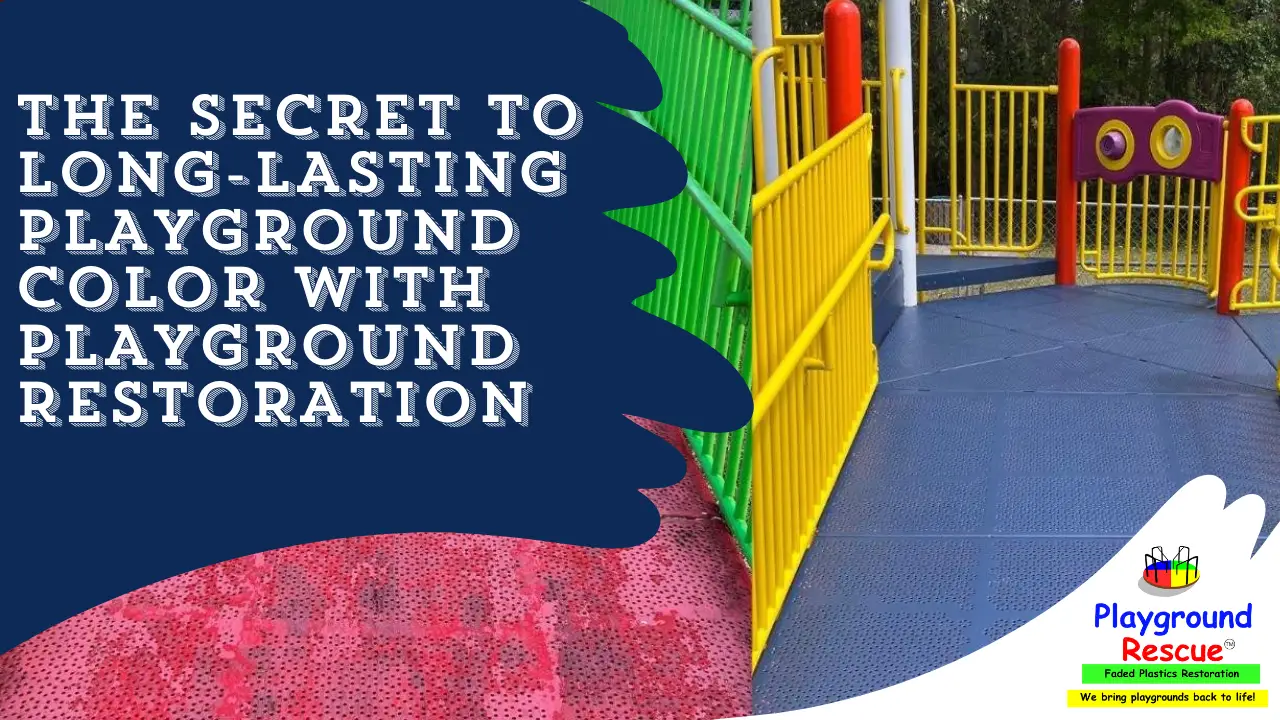
Why Playground Color Never Seems to Last
If you’ve ever tried to refresh faded playground equipment, you’ve probably asked the same question many facility managers do:
“Why does the color never last?”
Schools, parks, and HOAs often spend money repainting playground equipment, only to see fading, peeling, or chalking return within a year. This cycle creates frustration, wasted budgets, and skepticism toward restoration solutions.
The truth is, lasting playground color isn’t about paint, it’s about bonding.
In this article, we reveal the secret to long-lasting playground color, explain how professional playground restoration works, and why some methods fail while others last for years.
Why Playground Equipment Loses Color So Quickly
Playground equipment is constantly exposed to harsh outdoor conditions:
- UV radiation
- Heat and temperature swings
- Moisture and humidity
- Physical wear
Most playground plastics are made from polyethylene (PE) and polypropylene (PP). These materials are durable but classified as low surface energy plastics, which makes them difficult for coatings to adhere to.
What UV exposure does:
- Breaks down embedded pigments
- Causes oxidation and chalking
- Leaves surfaces dull and faded
Once this process starts, color loss accelerates unless properly addressed.
Why Paint Fails on Playground Equipment
Many organizations assume paint is the solution, but paint is actually the problem.
Why paint doesn’t last:
- Paint sits on the surface instead of bonding
- Low surface energy plastics reject paint adhesion
- Temperature changes cause cracking and peeling
Even “plastic paint” products are not designed for commercial playground use.
Result:
- Peeling within months
- Frequent reapplication
- Increased maintenance costs
This is why lasting playground color requires a different approach entirely.
The Secret: Cross-Link Bonding Technology
The secret to long-lasting playground color is molecular bonding, not surface coating.
Professional playground restoration uses Cross-Link Bonding Technology, which:
- Chemically bonds with playground plastics
- Penetrates beyond the surface layer
- Creates durable, flexible adhesion
Instead of sitting on top of the plastic, the restoration coating becomes part of the surface.
How Cross-Link Bonding Creates Long-Lasting Color
Cross-Link Bonding Technology works at a microscopic level.
Key benefits include:
- Strong adhesion to low surface energy plastics
- Flexibility during heat expansion and contraction
- Resistance to cracking, peeling, and flaking
- Even, consistent color restoration
This is why restored playgrounds maintain vibrant color for years, not months.
Why Heat-Based “Restoration” Methods Fail
Some companies use heat guns or torches to temporarily darken faded plastic. While this may look good initially, it’s a short-term illusion.
Problems with heat methods:
- Brings oils to the surface temporarily
- Accelerates plastic degradation
- Offers no UV protection
- Color fades again quickly
In contrast, true playground restoration:
- Adds protective UV resistance
- Preserves the plastic substrate
- Extends equipment lifespan
UV Protection: The Missing Piece
Restoring color without UV protection guarantees fading will return.
Professional playground restoration includes UV inhibitors that:
- Slow future fading
- Reduce oxidation
- Preserve restored color longer
This is critical in high-UV regions such as:
- Florida
- Texas
- Southern and coastal states
With proper UV protection, restored playground color typically lasts 5+ years outdoors.
Why Long-Lasting Color Saves Money
Long-lasting playground color isn’t just about appearance, it’s about budget efficiency.
When color lasts longer:
- Fewer maintenance cycles are needed
- Repainting costs are eliminated
- Replacement can be delayed for years
Playground restoration typically costs 70–80% less than replacement, making durability a major financial advantage.
How Long Does Playground Restoration Really Last?
Playground Rescue provides a 3-year no-fade warranty, but real-world performance often exceeds expectations.
Typical results:
- Outdoor playgrounds: 5+ years
- Shaded or indoor playgrounds: even longer
Because restoration can be repeated, playgrounds can remain visually appealing for decades without replacement.
What Types of Equipment Benefit Most From Restoration
Playground restoration works on:
- Plastic slides
- Roofs and canopies
- Panels and barriers
- Climbing structures
- Benches and site furnishings
If the equipment is structurally sound but faded, restoration is almost always the best first option.
Common Myths About Playground Restoration Color
Myth 1: “It’s just paint”
Reality: Restoration uses bonded coatings designed specifically for playground plastics.
Myth 2: “The color won’t last”
Reality: Professional restoration lasts years, not months.
Myth 3: “Replacement is the only permanent solution”
Reality: Restoration can be repeated, extending equipment life significantly.
Why Organizations Trust Playground Rescue
Playground Rescue has over 30 years of experience restoring faded plastics nationwide.
What sets Playground Rescue apart:
- Proprietary Cross-Link Bonding Technology
- No heat or torch methods
- On-site application with no disassembly
- 3-year no-fade warranty
- Nationwide service capability
Trusted since 1991, Playground Rescue delivers long-lasting playground restoration color schools and municipalities rely on.
Conclusion: The Real Secret to Long-Lasting Playground Color
The secret isn’t stronger paint or brighter pigment.
It’s:
- Proper surface preparation
- Molecular bonding
- UV protection
- Proven restoration technology
If your playground equipment is faded but structurally sound, playground restoration is the smartest way to achieve long-lasting color without replacement.
Want to restore long-lasting color to your faded playground equipment?
Contact Playground Rescue today for a free evaluation and see how restoration outperforms replacement.