
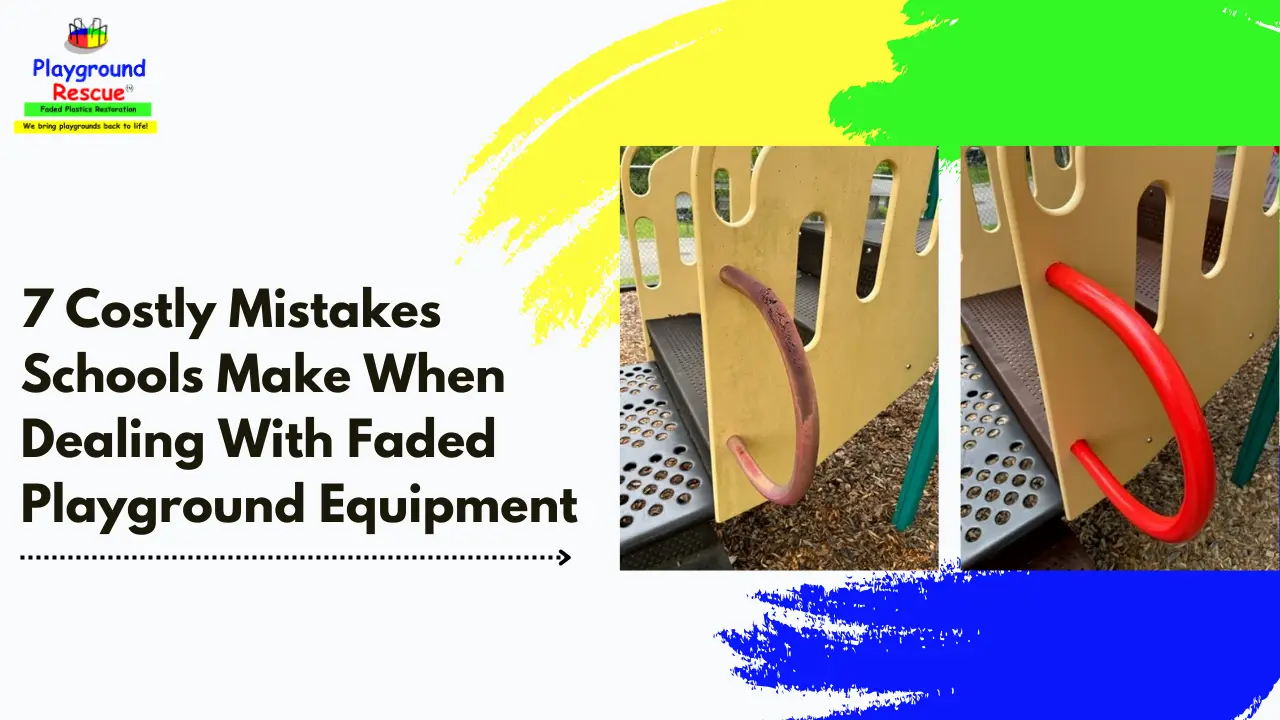
Why Faded Playground Equipment Becomes a School Budget Problem
Faded playground equipment is one of the most common, and misunderstood, facility challenges schools face. Over time, sun exposure causes playground plastics to lose color, leaving equipment looking worn, outdated, and neglected.
Parents notice. Staff notice. Administrators start hearing complaints.
Unfortunately, many schools respond by making costly decisions based on appearance alone. These decisions often drain budgets, shorten equipment lifespan, and create unnecessary disruption.
This article breaks down seven costly mistakes schools make when dealing with faded playground equipment, and how playground restoration provides a smarter, budget-friendly alternative.
Mistake #1: Assuming Faded Playground Equipment Is Unsafe
One of the biggest misconceptions schools make is assuming faded playground equipment is automatically unsafe.
The reality:
- Most playground equipment is made from polyethylene or polypropylene plastics
- These materials are designed to last decades structurally
- UV fading affects appearance, not strength
While safety inspections are always necessary, faded color alone does not indicate structural failure.
Why this mistake is costly:
Schools may rush into replacement when restoration would safely resolve the issue at a fraction of the cost.
Mistake #2: Replacing Equipment Instead of Restoring It
Replacing playground equipment is often seen as the default solution, but it’s usually unnecessary.
Replacement involves:
- Equipment removal and disposal
- New equipment purchase
- Installation and labor costs
- Playground downtime
Total costs often exceed $50,000–$150,000 for a single playground.
Playground restoration, by comparison:
- Costs up to 70–80% less
- Requires no disassembly
- Can be completed on-site in days
Mistake #3: Using Paint or DIY Products on Playground Equipment
Some schools attempt to fix faded playground equipment using:
- Consumer spray paints
- “Plastic paint” products
- Maintenance staff DIY solutions
Unfortunately, playground plastics are low surface energy materials, meaning paint does not bond properly.
Results of DIY painting:
- Peeling and flaking within months
- Increased maintenance cycles
- Potential safety and liability issues
Professional playground restoration uses bonding technology, not paint.
Mistake #4: Ignoring UV Protection After Fading Occurs
Even if schools improve the appearance temporarily, many fail to address the root cause, UV exposure.
Without UV protection:
- Fading quickly returns
- Surfaces oxidize faster
- Maintenance costs increase
Professional playground restoration includes UV-resistant coatings that slow future fading and extend equipment life.
Mistake #5: Waiting Too Long to Address Faded Playground Equipment
Delaying action is another costly mistake.
As oxidation worsens:
- Surfaces become chalky and brittle
- Restoration becomes more difficult
- Visual impact worsens
Early intervention through playground restoration:
- Preserves surface integrity
- Produces better visual results
- Extends lifespan longer
Proactive maintenance always costs less than reactive replacement.
Mistake #6: Overlooking Community Perception and Liability
Faded playground equipment doesn’t just look bad, it affects perception.
Parents may associate faded equipment with:
- Poor maintenance
- Safety concerns
- Neglect
This perception can lead to:
- Increased complaints
- Board scrutiny
- Liability concerns
Restored playgrounds communicate care, safety, and professionalism, even when the equipment is older.
Mistake #7: Choosing Inexperienced Restoration Providers
Not all “restoration” services are equal.
Some providers:
- Use consumer-grade coatings
- Rely on heat or torch methods
- Lack experience with playground plastics
These approaches can:
- Damage the plastic substrate
- Accelerate degradation
- Deliver short-lived results
Playground Rescue uses proprietary Cross-Link Bonding Technology developed specifically for playground plastics.
Why Playground Restoration Is the Smart Choice for Schools
Playground restoration allows schools to:
- Preserve safe, existing equipment
- Stretch limited capital budgets
- Minimize playground downtime
- Improve campus appearance
With a 3-year no-fade warranty and results that often last 5+ years, restoration offers long-term value.
When Schools Should Consider Replacement Instead
Replacement may still be necessary if:
- Equipment is structurally damaged
- Components are unsafe or broken
- Playground no longer meets code
A professional assessment ensures schools choose the right solution, not the most expensive one.
Why Schools Nationwide Trust Playground Rescue
Playground Rescue brings over 30 years of experience restoring faded playground equipment for schools across the U.S.
What schools value most:
- No disassembly required
- On-site application
- Proven bonding technology
- Significant cost savings
- Minimal disruption to school schedules
Trusted since 1991, Playground Rescue helps schools restore playgrounds instead of replacing them.
Conclusion: Avoid Costly Mistakes With Faded Playground Equipment
Faded playground equipment doesn’t have to result in massive replacement costs.
By avoiding these common mistakes and choosing professional playground restoration, schools can:
- Save money
- Extend equipment life
- Improve appearance
- Reduce complaints
Is your school dealing with faded playground equipment?
Contact Playground Rescue today for a free evaluation and discover how restoration can save your school thousands.